If you have been told you may need a pacemaker, the first question most people ask is how does cardiac pacing work, and the answer is reassuringly simple: a small implanted device watches your own heartbeat continuously and delivers tiny, painless electrical impulses only when your heart’s natural electrical system fails to do the job itself.
Those impulses travel through thin insulated wires (pacing leads) into the heart muscle, prompting it to contract and keeping your heart rate within a safe range. Most pacing systems are implanted under local anaesthetic in a procedure lasting around an hour, usually as a day case or with a single overnight stay, and most patients return to normal activity within a few weeks.
This guide has been prepared by Dr Navin Chandra, a Consultant Interventional Cardiologist practising in East Berkshire & South Buckinghamshire. Alongside coronary intervention (PCI and stenting) and transcatheter aortic valve implantation (TAVI), permanent pacemaker implantation is one of his core procedures, and he also holds specialist interests in sports cardiology and inherited cardiac conditions. The aim here is to explain cardiac pacing clearly, without jargon, so that any conversation about diagnosis, treatment options and recovery feels far less daunting.
How Does Cardiac Pacing Work Inside the Heart?
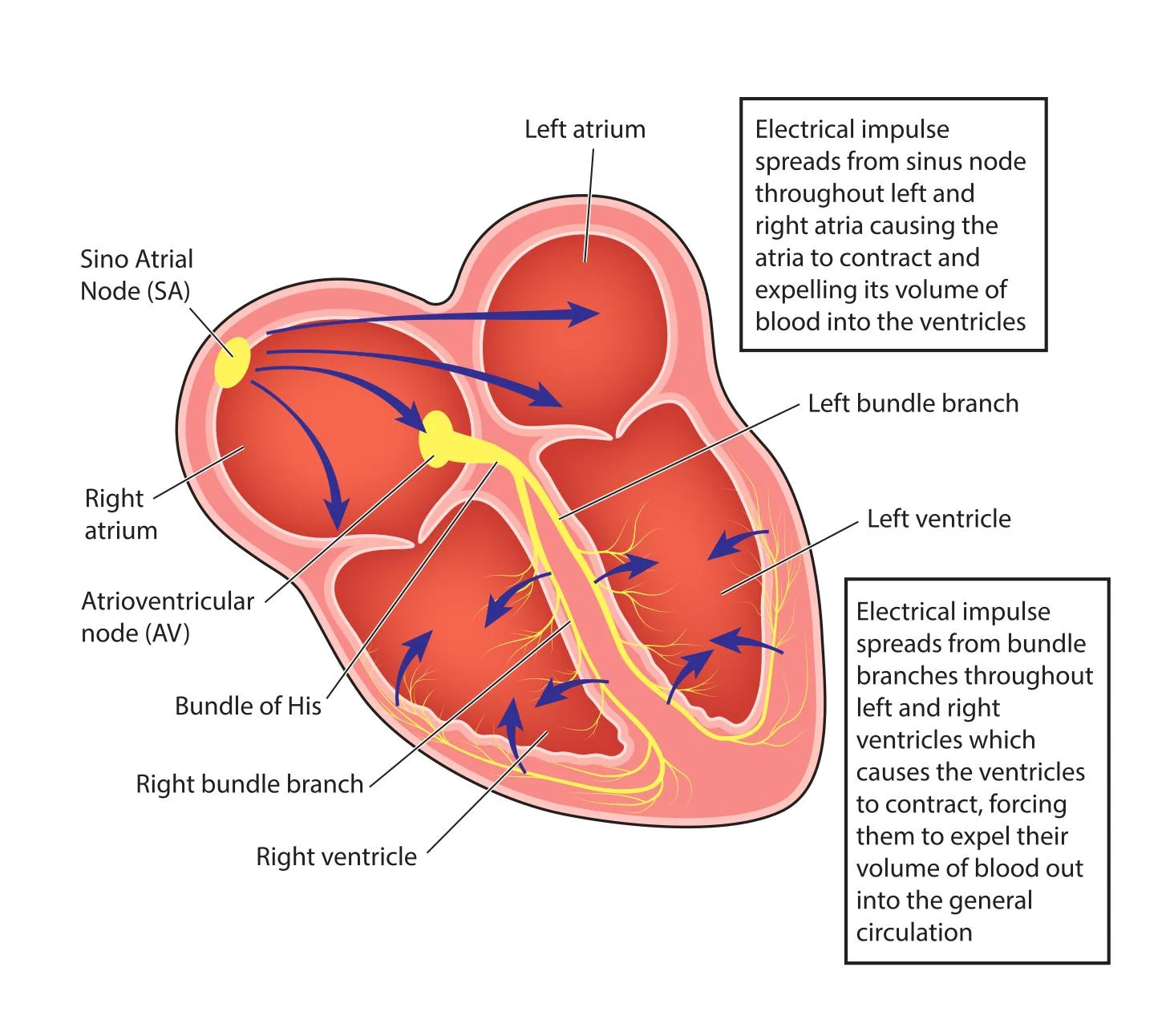
To understand how does cardiac pacing work, it helps to know that your heart already has its own pacemaker. A cluster of specialised cells in the right atrium, called the sinoatrial node, generates an electrical signal roughly 60 to 100 times a minute at rest. That signal spreads across the atria, passes through a relay station called the atrioventricular node, then travels down conducting fibres into the ventricles, the main pumping chambers. Each electrical wave triggers a coordinated squeeze, and that squeeze is what you feel as your pulse.
Problems arise when that wiring becomes unreliable. The sinoatrial node may fire too slowly or pause (sinus node disease), or the signal may be delayed or blocked on its way to the ventricles (heart block). The result can be a heart rate that is too slow to meet the body’s needs, a condition known as bradycardia. Symptoms may include dizziness, unexplained tiredness, breathlessness, palpitations and blackouts or near blackouts.
An implanted pacemaker acts as a dependable backup for that natural system. It does two things continuously: it senses the heart’s own electrical activity, and it paces only when needed.
How does cardiac pacing work when your own rhythm is normal?
Modern devices are designed to stay out of the way. When the pacemaker detects a normal, timely heartbeat, it simply records it and withholds its own impulse. This is called inhibited pacing, and it is one reason batteries last for many years. In practice, some patients are paced almost every beat, while others are paced only occasionally, perhaps at night or during a pause.
How does cardiac pacing work during exercise or exertion?
A healthy heart speeds up when you walk uphill or climb stairs. Pacemakers can replicate this in two ways. If the atria are still generating their own signals normally, the device can track that natural acceleration and pace the ventricles in step with it. If the atria cannot speed up appropriately, sensors within the device (often detecting body movement or changes in breathing) can increase the paced rate. This feature, known as rate response, is one of many settings a Cardiologist can adjust to suit your lifestyle, which matters particularly for active patients and athletes.
What Are the Main Parts of a Pacing System?
A conventional permanent pacemaker has three components working together:
- The pulse generator: a sealed titanium box, roughly the size of a matchbox, containing the battery and the computer circuitry. It sits just under the skin below the collarbone, usually on the left.
- The leads: flexible insulated wires passed through a vein into the heart. They carry information from the heart to the device and impulses from the device to the heart.
- The electrodes: the tips of the leads, which make contact with the heart muscle and deliver the pacing impulse.
Leadless pacemakers are also now available for selected patients. These are self-contained capsules placed directly inside the right ventricle via a vein in the leg, with no chest incision and no leads.
Which type of pacemaker might be recommended?
The choice depends entirely on which part of the electrical system is failing:
- Single chamber pacemaker: one lead, placed in either the right atrium or the right ventricle. Often used when only one chamber needs support.
- Dual chamber pacemaker: two leads, one in the right atrium and one in the right ventricle, so the device can preserve the natural timing between the upper and lower chambers. This is commonly used in atrioventricular block.
- Biventricular pacemaker (cardiac resynchronisation therapy): paces both ventricles to improve coordination in selected patients with heart failure and specific conduction delays.
- Leadless pacemaker: a single capsule in the right ventricle for suitable candidates.
How Is the Need for Cardiac Pacing Diagnosed?
Before pacing is considered, the priority is establishing whether your symptoms are genuinely caused by a slow or unreliable heart rhythm. Assessment typically begins with a detailed history, a physical examination and an electrocardiogram (ECG). Because intermittent rhythm problems can easily be missed on a single tracing, longer monitoring is often needed.
- Ambulatory ECG monitoring over 24 hours to several weeks
- Echocardiography to assess heart structure and pumping function
- Exercise testing to see how the heart rate responds to exertion
- Blood tests and medication review, since some tablets slow the heart rate
- Coronary or structural imaging where underlying disease is suspected
Pacing is generally recommended when there is a clear link between symptoms and documented bradycardia, or when the pattern of heart block carries a risk of dangerous pauses even without prominent symptoms.
How Does Cardiac Pacing Work in Practice on the Day of the Procedure?
Understanding how does cardiac pacing work during implantation removes much of the anxiety. The procedure is carried out in a catheter laboratory using X-ray guidance, with local anaesthetic and usually light sedation, so you remain awake but comfortable.
- The skin below the collarbone is cleaned, and antibiotics are given.
- After local anaesthetic, a small incision of a few centimetres is made and a vein is accessed.
- The lead or leads are guided into position within the heart under X-ray.
- Electrical measurements confirm the leads sense and pace reliably.
- The generator is connected, placed in a pocket under the skin, and the wound is closed.
Most implants take around 60 to 90 minutes. A chest X-ray and a device check are usually performed before discharge, and you will be given a device identification card to carry.
What does recovery involve?
Discomfort and bruising around the wound for a week or two are common. Patients are generally advised to avoid raising the arm on the implant side above shoulder height and to avoid heavy lifting for a few weeks, allowing the leads to settle. Driving rules matter too: DVLA guidance on cardiovascular disorders and fitness to drive requires car and motorcycle drivers to stop driving for at least a week after pacemaker implantation and to notify the DVLA, with stricter rules for bus and lorry licences.
What Are the Risks and Limitations?
Pacemaker implantation is a well established and generally safe procedure, but no intervention is risk free. Possible complications include bruising or a blood collection at the site, wound infection, lead displacement requiring repositioning, a small risk of collapsed lung (pneumothorax) when the vein is accessed, and very rarely fluid around the heart. Your clinician will explain these in the context of your own health before you consent.
Day to day life is usually unrestricted. Household appliances, mobile phones and airport security are not a problem when sensible precautions are followed, though strong magnetic fields and certain industrial equipment should be avoided. Many modern devices are MRI conditional, meaning scans can be performed under specific conditions, so always tell radiology staff you have a pacemaker. Batteries typically last several years, commonly around a decade, and replacement involves changing the generator rather than the leads. Remote monitoring allows many checks to be done from home between clinic appointments.
Frequently Asked Questions
How does cardiac pacing work in simple terms?
A pacemaker constantly monitors your heartbeat. If your heart beats normally, it does nothing. If your heart is too slow or pauses, it sends a small painless electrical impulse through a lead to make the heart muscle contract, keeping your rate within safe limits.
Will I be able to feel the pacemaker working?
Most people feel nothing at all once healing is complete. The impulses are far too small to sense. Occasionally patients notice the device under the skin or become aware of a change in heart rate, which is worth mentioning at a device check.
Can a pacemaker stop a heart attack?
No. A pacemaker treats electrical rhythm problems, not blocked arteries. Heart attacks are caused by reduced blood flow to the heart muscle and are treated differently, often with angioplasty and stenting. Separate assessment of coronary risk factors remains important.
How long will I stay in hospital?
Many pacemaker implants are performed as day cases, with discharge the same day after a wound check, chest X-ray and device test. Some patients stay overnight, particularly if the procedure is done later in the day or other medical issues need monitoring.
Does a pacemaker mean I have to stop exercising?
Usually not. After initial healing, most patients resume walking, cycling, swimming and gym activity. Device settings can often be tailored to support an active lifestyle, though contact sports may need discussion. Ask your Cardiologist for advice specific to your sport.
Where can I be assessed for cardiac pacing near me?
Assessment involves symptom review, ECG, rhythm monitoring and echocardiography. A specialist consultation will clarify whether pacing, medication review or further tests are the right next step.
Cardiac pacing is one of the most reliable and well understood treatments in Cardiology: a discreet device that quietly supports your heart’s own electrical system and restores confidence in everyday activity. Understanding how cardiac pacing works, what the assessment involves and what recovery looks like makes shared decision making much easier. If you are experiencing dizziness, blackouts, unexplained breathlessness or palpitations, or you have been advised that a pacemaker may be needed, you can arrange a specialist consultation with Dr Navin Chandra to discuss your symptoms, diagnosis and treatment options in detail.
Have Questions About Your Heart Health?
Schedule a consultation with Dr Chandra to discuss personalized strategies for maintaining optimal cardiovascular health.